How CPC Signs Got NetSuite's Customer-Specific Pricing Working in BigCommerce B2B Edition
Read the Article

Selling custom apparel online sounds straightforward enough. Someone chooses a shirt, uploads a logo, selects a few customization options, and places an order. A few days or weeks later, their finished apparel arrives.
Of course, there's quite a bit happening between those two moments.
Someone has to make sure the correct artwork gets to manufacturing, the logo ends up on the right side of the shirt, the pricing reflects every customization, and the finished product makes it to the right customer. Add international manufacturing, multiple subsidiaries, and different currencies to the equation, and things start getting interesting.
Anchor Group recently worked with a custom apparel manufacturer generating more than $100 million in annual revenue on a project involving NetSuite, headless BigCommerce, and Celigo. The company needed its ecommerce, manufacturing, and financial processes to work together across international operations, without losing the product customization details that make its business unique.
Here's a closer look at the customer's challenges, the technology involved, and how our team approached the solution.
The company specializes in customized apparel for organizations like sports teams and leagues. Think jerseys, shirts, and other garments featuring custom logos, embroidery, sponsorship placements, and printed designs.
The business primarily sells directly to consumers, although many of its manufacturing requirements are similar to those of B2B apparel manufacturers and promotional products companies.
Its operations span multiple countries. The primary distribution entity is based in the United States, while manufacturing takes place in Central America. Products are manufactured internationally, shipped back to the US, and then distributed to the final customer.
That's a lot of moving pieces for what the customer experiences as a single online purchase.
Behind the scenes, the company needs to coordinate ecommerce orders, manufacturing instructions, inventory movements, and financial transactions between separate business entities. And because those entities operate in different countries, multicurrency accounting adds another layer of complexity.
Three major considerations shaped the project.
First, the company's NetSuite environment needed to support both its US distribution operations and its international manufacturing subsidiary. Those entities have different responsibilities, but they still need to transact with one another while maintaining accurate financial records.
Second, the ecommerce storefront needed to capture detailed product customization information. Customers weren't simply purchasing standard products. They needed to specify artwork, logo placements, printing options, sizes, and other details that could affect both pricing and manufacturing.
Finally, all that information needed to move reliably between systems. A customer could configure the perfect jersey online, but if the manufacturing team received an order without the correct artwork placement instructions, the company could end up producing something the customer never ordered. Potentially an expensive mistake, especially when that order includes an entire team's uniforms.
The challenge was designing a process that supported the customer's actual operations, from the initial online order through manufacturing, accounting, and final fulfillment.
In this video, Caleb Schmitz and Michael from Anchor Group discuss the customer's NetSuite subsidiary structure, its headless BigCommerce storefront, and why Celigo was selected to connect the systems. They also explain some of the technical considerations that manufacturers and promotional products companies should keep in mind when designing similar processes.
One of the first considerations was how to structure the company's entities within NetSuite.
The customer had an existing US distribution subsidiary and needed to accommodate an additional international manufacturing subsidiary within the same NetSuite environment.
The approach involved organizing the two operating subsidiaries under a parent-level hierarchy.
The US distribution subsidiary would handle customer-facing transactions, including ecommerce sales orders and final fulfillment. The international subsidiary would manage the manufacturing activities responsible for producing those customized products.
Both subsidiaries needed to maintain their own operational and accounting records while operating within the same NetSuite environment.
Caleb also emphasized the value of planning that hierarchy with future changes in mind. A parent-level structure within NetSuite can provide organizational flexibility, even when there isn't a separate legal holding company above both entities. However, the ERP hierarchy still needs to align with the company's actual legal, accounting, and reporting requirements.
It's one of those architectural decisions that's worth thinking through at the beginning, because reorganizing an ERP environment later is rarely anyone's favorite project.
For manufacturers managing multiple entities, our NetSuite OneWorld guide for manufacturers explains how NetSuite supports subsidiary structures, multicurrency accounting, and international operations.
With the subsidiary structure established, the next consideration was how customer orders would move between distribution and manufacturing.
Let's say a customer purchases a customized team jersey through the ecommerce website.
The order belongs to the US distribution business, but the jersey is manufactured by the international subsidiary. From an accounting standpoint, those are two separate entities, so the transactions between them need to be recorded appropriately.
1. Customer places an order: The customer purchases a customized product through BigCommerce.
2. Sales order enters NetSuite: The ecommerce order is transferred into the US distribution subsidiary.
3. Intercompany transaction: The distribution order leads to the appropriate intercompany transaction, allowing the manufacturing subsidiary to receive the corresponding order requirement.
4. Manufacturing work order: The international subsidiary creates and processes a work order using the customer's customization requirements.
5. International shipment: The finished products are shipped from the manufacturing subsidiary to the US distribution entity.
6. Final fulfillment: The US subsidiary receives the inventory and ships the completed order to the customer.
The intercompany process is particularly important because each subsidiary effectively treats the other as a customer or vendor for the relevant transactions. NetSuite needs to support those relationships while keeping the financial activity properly recorded.
Because the entities operate in different countries, the process also needs to account for transactions involving multiple currencies.
The goal is to make the operational process work without compromising the financial records. Manufacturing needs accurate production instructions, distribution needs visibility into incoming inventory, and finance needs the transactions between subsidiaries to be recorded correctly.
For apparel manufacturers and promotional products companies that rely on international production facilities, getting this structure right is an important part of the overall NetSuite implementation.

The next consideration was the ecommerce platform itself.
The customer wanted a strong direct-to-consumer shopping experience that could support the complexity of its products while connecting effectively with NetSuite.
The company ultimately chose a headless BigCommerce storefront.
In a headless ecommerce setup, the customer-facing website is separated from the underlying ecommerce platform.
For this customer, that meant using a custom-built storefront while retaining BigCommerce functionality for important ecommerce processes, including the cart and checkout.
This gave the business greater control over how customers interacted with its products, including how customization options were presented and captured.
And for custom apparel, those product pages have quite a bit of work to do.
Consider an ordinary embroidered shirt.
A customer might need to select the size, upload a logo, specify whether the artwork belongs on the left or right chest, and decide if additional embroidery should appear on the sleeve.
Some of those choices affect pricing. Others tell the manufacturing team exactly what to produce.
The website needs to capture that information, preserve it through checkout, and make it available to the systems responsible for fulfilling the order.
There are several technical ways to accomplish this in BigCommerce.
As Caleb explains in the video, customization selections can be captured through product-page fields and other data-handling methods. Depending on the implementation, those details can be incorporated into product descriptions or stored in other structured formats that can be processed after checkout.
If you're evaluating ways to capture those customization details, our BigCommerce promotional products playbook explores the options, including native features, apps, integrations, and custom development.
For example, a customer ordering a jersey might select a particular logo placement and an additional sleeve design. The storefront needs to retain those selections, reflect any applicable price adjustments, and associate the information with the correct product when the order is placed.
This is where the flexibility of the headless approach becomes particularly valuable. The customer-facing experience can be designed around the manufacturer's actual product configuration requirements while BigCommerce continues handling the underlying ecommerce transactions.

Capturing customization information in BigCommerce is only part of the process. The next challenge is making sure NetSuite receives it in a format the manufacturing operation can use.
For this project, the approach involved transferring custom product details alongside the ecommerce order and associating them with the appropriate NetSuite sales order lines.
That could mean storing customization information in a designated sales order column or description field, depending on how the order data is structured.
The information can then be parsed or referenced as needed to support the manufacturing process.
Think back to the embroidered shirt. When the order reaches NetSuite, the manufacturing team needs more than the garment's item number and quantity. They also need the logo placement, embroidery specifications, and other instructions associated with that particular order.
There are also opportunities to introduce additional approval workflows when a business needs them.
For example, a custom apparel manufacturer might require artwork approval before releasing an order to production. NetSuite can support workflows for managing those requirements, although the specific process depends on the company's needs.
After all, it's a lot easier to correct a misplaced logo on a digital preview than on 500 finished jerseys.
With the ERP and ecommerce requirements established, the next piece was getting the two systems to communicate.
For this project, Anchor Group selected Celigo as the middleware platform connecting BigCommerce and NetSuite. The integration needed to transfer more than standard ecommerce order data. Product customization details also had to reach the appropriate NetSuite sales order lines so the manufacturing team could use those instructions when producing each order.
There are several ways to connect ecommerce platforms with NetSuite, including prebuilt integrations and custom development. But with complex product configurations and international manufacturing requirements, flexibility was an important consideration.
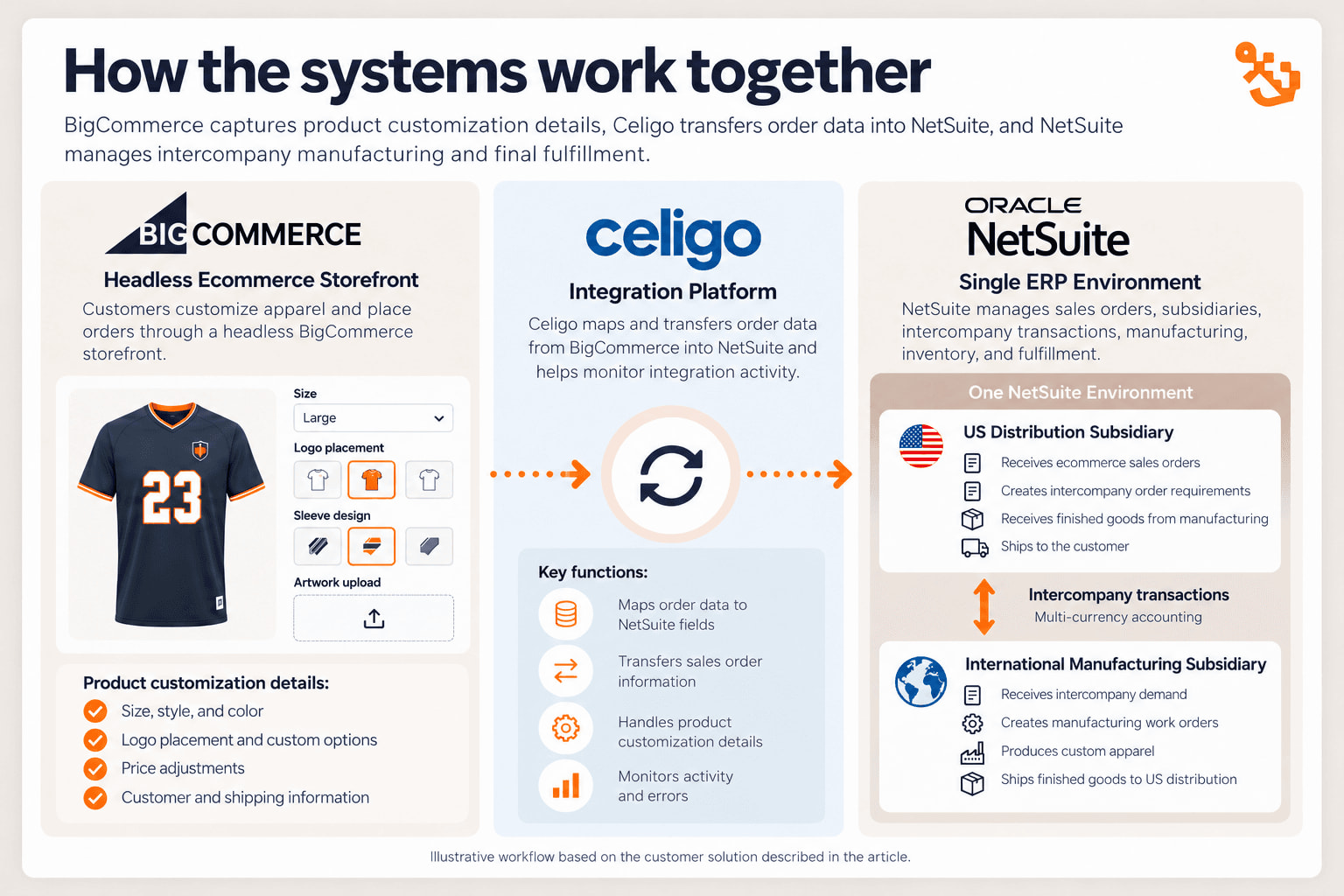
A conventional ecommerce integration typically handles information like customer records, items purchased, quantities, prices, and shipping details.
This manufacturer needed additional information to move between systems.
Celigo provided the flexibility to configure integration flows around the customer's order data, including the customization attributes captured through BigCommerce.
That meant our team could work with how the information was structured in the storefront, determine how it should be mapped into NetSuite, and accommodate the additional fields needed to support manufacturing.
A prebuilt connector can be a useful starting point, but specialized product requirements may call for additional configuration and custom flows.
That's one of the reasons selecting the right integration platform matters.
You want the systems to support how the business actually operates, rather than asking the operations team to change its process every time the integration encounters something slightly unusual.
For a more detailed look at the technical setup, our guide to connecting BigCommerce to NetSuite with Celigo walks through the integration process, data flows, and common configuration challenges.
Flexibility wasn't the only consideration.
The customer processes a high volume of direct-to-consumer orders, which makes integration monitoring and error handling particularly important.
Celigo provides functionality for identifying failed integration flows, monitoring activity, and troubleshooting issues.
And because the ecommerce storefront operates separately from NetSuite, BigCommerce can continue accepting orders during certain integration interruptions.
Those orders still need to be transferred once the connection is restored, but the separation means a temporary integration problem doesn't necessarily have to stop customers from checking out.
For manufacturers, that visibility matters. A failed order transfer can affect production schedules, inventory planning, and eventually delivery expectations.
Being able to identify and address those problems quickly is an important part of keeping the overall process moving.
The decision to use Celigo also considered the company's potential future technology needs.
As a middleware platform, Celigo can connect with additional systems beyond BigCommerce and NetSuite.
For example, if the manufacturer eventually expands into marketplaces like Amazon or Walmart, those platforms could potentially become part of its broader integration architecture.
Those additional marketplace connections weren't the focus of this project, but considering them early helps avoid unnecessarily restrictive technology decisions.
A well-designed integration should address the requirements in front of you without making the next phase of growth more complicated than it needs to be.
Although this project involved a custom apparel manufacturer, many of the same challenges apply to promotional products businesses and other companies selling configurable products online.
The details will look different depending on the products and manufacturing processes, but several considerations are worth addressing before implementing a similar technology stack.
These are all questions worth answering before an implementation gets underway. It's considerably easier to build the right process from the beginning than to untangle a collection of manual workarounds after everyone has gotten used to them.
For a custom apparel manufacturer, an order isn't finished moving through the business when it reaches NetSuite. The manufacturing team still needs the right artwork instructions, inventory needs to move between entities, and finance needs to account for those transactions across currencies.
That's why the decisions made in the ecommerce storefront, ERP structure, and integration architecture have to account for the entire process.
For this customer, that meant organizing NetSuite around its international operations, using headless BigCommerce to support detailed product customization, and selecting Celigo to connect ecommerce orders with the ERP processes responsible for manufacturing and fulfillment.
It's a useful example of why understanding the business process matters just as much as understanding the technology.
At Anchor Group, we work with companies navigating these kinds of NetSuite integration challenges, including complex ecommerce requirements, international operations, and custom manufacturing workflows.
If your custom product orders aren't making it cleanly from ecommerce into NetSuite, or international manufacturing has made your ERP processes more complicated than they need to be, we're happy to help you sort through the details.
Bring us the complicated part. We'll help you figure out what to do with it. Contact us >
Related Articles
Tagged with Manufacturing