NetSuite Optimization Case Study: How CPC Signs Connected NetSuite, BigCommerce, and Celigo
What a large-scale, cross-platform ERP go-live recovery and optimization looks like, and all the nitty gritty details that implementation partners don't like to talk about.
Date
September 18, 2026
Read
17 min
Traffic, safety, and municipal signage. Quite possibly the most important (and ubiquitous) things for ensuring and maintaining safe travel and operations in the known world.
CPC Signs lives in the center of this wonderfully vibrant space. And while their manufactured products may be bold, reflective, and legally important, the back-office systems supporting them cannot afford to be quite so attention-seeking. This is an industry where details and accuracy matter and can be the difference between an uneventful drive to the office and four-car pileup (dramatic, but true).
And while it’s tempting to assume all it takes is a customer on CPC Signs’ website to say, “sounds great, one stop sign, please,” sourcing the right sign with the right pricing, the right fulfillment path, and the right data moving between disparate systems requires an adherence to precision, accuracy, and timeliness beyond what a manual workflow can do.
Before NetSuite, CPC Signs had learned this the hard way: through huge Excel spreadsheets, endless data cleanup, bad addresses, incomplete emails, and the realization that their existing ERP system was not so much supporting operations as it was requiring everyone to work around it. The internal team found themselves spending chunks of their time cleaning and re-uploading data, removing bad information, and doing the kind of operational housekeeping that makes people start whispering things like, “I can’t go on like this,” which is commonly how the ERP story begins.
So CPC Signs made the logical nextstep of moving to NetSuite and added other systems into the mix, including BigCommerce for eCommerce, Celigo as a NetSuite integration platform, and ShipHawk as part of the fulfillment ecosystem.
The technology was there and the table was set. So, the obvious next challenge was making it all work together, where NetSuite optimization goes from being a nice-to-have to a business requirement.
When a NetSuite implementation looks better on paper than it does in real life
Now on paper, this is exactly the kind of tech stack a growing traffic and municipal signage company should want: NetSuite at their operational core, BigCommerce powering the customer-facing experience, integrations keeping data moving, and enough customization potential to support the parts of the business that do not fit neatly into a default solution.
Of course, “on paper” is also where a lot of NetSuite implementation projects look their very best.
When as CPC Signs got closer to go-live and then moved into the realities of post-launch operations, the team began running into the kind of problems that many NetSuite and BigCommerce power users recognize immediately: the standard setup was not quite enough, the business logic was more nuanced than expected, NetSuite integrations needed to do more than simply pass data from Point A to Point B, and the internal team didn't have a NetSuite developer on the team to build every obscure-but-important customization themselves.
Post-go-live NetSuite optimization: Where standard functionality started to bend
A rough ERP go-live is a little like moving into a new house before the punchlist is complete. Technically, you live there now. Technically, there is a sink. Technically, dinner could happen. But everyone knows there are a few drawers that do not close correctly, one light switch that controls something no one has figured out yet, and a growing list of “things we need to deal with after move-in” items taped to the refrigerator.
For CPC Signs, the post-go-live reality was that they were trying to fit real, business-specific CPC workflows into an out-of-the-box system structure that wasn’t designed to accommodate all their requirements.
Several areas emerged as priorities:
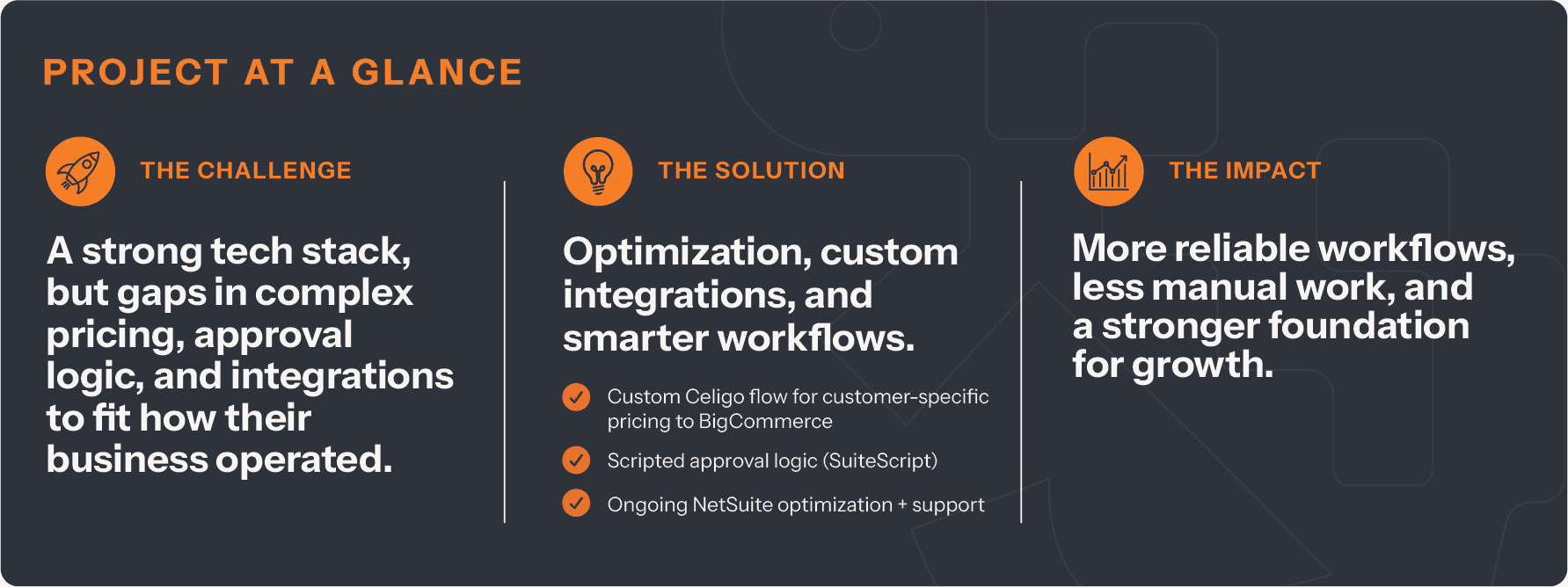
Customer-specific pricing between NetSuite and BigCommerce
Complex NetSuite order management and sales order approval logic
Integrations that needed to be understood in context instead of treated like isolated technical tickets
NetSuite customizations that needed to solve genuine business requirements without creating unnecessary long-term maintenance
This is where optimization work gets interesting (excuse us as we nerd out about this).
Solving a complicated NetSuite integration between BigCommerce and Celigo
Customer-specific pricing became one of the more complicated examples, and a particularly great example of why NetSuite integration services aren't simply about connecting APIs.
CPC Signs had NetSuite, BigCommerce, and Celigo in the mix, meaning pricing data needed to move between the systems correctly and consistently without fail.
Now, NetSuite gives companies several levers for assigning customer pricing, where a customer can receive one price level across the board, a special price for a particular group of items, or bespoke pricing on individual SKUs. And CPC used a combination of these price levels and group pricing for government customers—which worked great inside NetSuite. BigCommerce, however, supports a much flatter approach, where they only support applying a specific price list to a customer.
The truth is, a feature like “customer-specific pricing” is one of those things that sounds easy on a project brief, but then immediately turns into an overtired three-year-old once you try to make it work across an ERP, an eCommerce platform, and an integration layer.
This created the real NetSuite integration challenge for Anchor Group's consultants: How do we translate nuanced, multi-layered pricing rules from NetSuite into BigCommerce, where the flattened structure BigCommerce expects would create an enormous manual maintenance problem?
Using the Celigo NetSuite connector to translate pricing logic
Rather than brute-forcing the solution, Anchor Group used the Celigo NetSuite connector to build a custom flow capable of interpreting CPC's multi-layered NetSuite pricing structure, flattening it, and transforming it into a format BigCommerce could support while keeping the customer-specific pricing logic accurate. This Celigo NetSuite integration allowed CPC's customer-specific pricing rules to move between the ERP and ecommerce environment more accurately while keeping maintenance manageable for the internal team.
Now, before we move on, we want to emphasize the difference between just buying an integration tool out of the box vs designing an effective ecommerce integration with NetSuite. It's important to keep in mind that the connector (in this case Celigo) is only one piece. The much harder part of a complex NetSuite ERP integration like this is understanding the rules behind the information being moved, NetSuite configuration, ecommerce architecture, customer pricing logic, and the integration layer—all at the same time.
For CPC, this meant combining Celigo with custom NetSuite integrations, custom BigCommerce integrations, and business-specific logic instead of pretending an out-of-the-box mapping could solve every edge case the client would come across.
A real-world NetSuite workflow example: When approval logic becomes too complex and outgrows the workflow
Another major area of work involved CPC's sales order approval process.
We're highlighting this particularly useful NetSuite workflow example because the original approach wasn't necessarily wrong—it just stopped being the right tool for CPC Signs as their business logic became more complicated. Upon implementation, CPC used NetSuite workflows to manage approvals, which makes sense: a standard NetSuite workflow is often the first place teams look when NetSuite needs to follow a defined path.
But (heavy emphasis here), CPC's approval logic wasn't a simple route from A to B.
Rather, the process needed to evaluate criteria sequentially: start here, check this condition, proceed if it isn't met, evaluate another condition, and continue through multiple rules until NetSuite arrived at the correct approval outcome.
Eventually, the process reached seven decision points, which, at that point, was making the workflow clunky and less reliable than the business needed it to be.
When NetSuite workflow customization taps out, scripting can step in
Before we continue, we'd like to emphasize that scripting is not always the right answer.
It's not something we recommend willy-nilly whenever configuration becomes inconvenient. Scripts have maintenance implications, and any NetSuite partner pretending otherwise should be gently escorted away from the whiteboard.
But, there are situations where NetSuite workflow customization has reached its practical limit (the key is recognizing when this has happens). This was one of them.
Instead of continuing to stretch workflows past the point where they were easy to manage, Anchor Group's NetSuite developers moved the approval logic to a more structured, scripted solution. Using SuiteScript, the team could create approval logic that more closely reflected how CPC's business rules operated rather than forcing six or seven increasingly complicated decision points through the original workflow. Much more elegant.
And much more useful for CPC, too, because that meant that a NetSuite sales order approval process that more closely matched real-world requirements.
The difference between necessary and unnecessary NetSuite customization
The key is understanding the difference between unnecessary customization and necessary customization, which is a big part of responsible custom NetSuite development and why finding a good NetSuite implementation partner is so crucial for long-term success.
Unnecessary customization makes the system more fragile for no good reason. That's why it’s very important to assess what other out-of-the box possibilities exist to solve a problem first—even if it means tweaking legacy workflows.
Necessary customization helps NetSuite reflect the actual rules of the unique business, especially when the alternative is forcing users into awkward manual workarounds or brittle workflows that become harder to maintain over time.
For CPC, the goal was to determine where native functionality worked, where configuration could solve the problem, where an integration was the right answer, and where scripting genuinely made more sense.
Good NetSuite customization services should work the same way. And when a project requires NetSuite development services, those decisions should be made in the context of the larger system—not just as isolated technical requests—which is especially important as the number of connected platforms and customizations grow.
In CPC's case, the scripted sales order approval process that was developed as the answer helped create logic that better matched how approvals needed to happen in the real world.
Why good NetSuite consultants need to understand more than the ticket
One of the most cumbersome parts of any big ERP project is explaining the nuances of the project and the business every time someone new joins the conversation, while also monitoring to ensure continuity challenges or knowledge gaps don’t arise.
CPC Signs had experienced that kind of revolving door support before: a main point of contact who understood the request at a surface level, followed by a rotating cast of technical resources who had to be brought up to speed before they could be useful.
While this can work for certain types of simple support, it becomes Exhausting (with a capital E) when the work is highly specific to your organization, your NetSuite configuration, your ecommerce logic, and your integration architecture.
Our approach to consulting looks a little different.
CPC worked closely with our consultant Mitch, who stayed (and continues to stay) involved throughout CPC’s various projects with us and became familiar with how their business operates. This is the type of relationship continuity that matters, because optimization work is rarely just about writing a script or updating a field. And it’s definitely not a one-and-done process either. Rather, in our approach, consultants develop a fluent level of understanding in why the organization’s workflows exist, where the data comes from, who depends on it, what happens if it breaks, and which parts of the business will start sending alarmed emails if the system behaves unexpectedly.
This familiarity also makes the relationship easier. Or, as Tripp put it,
Biggest benefit
The biggest benefit for us is that we’re talking to the same people every single time. They know how our business operates.
Shifting the relationship from a transaction to an interaction is an important difference between hiring technical resources and building a long-term, working relationship with experienced NetSuite consultants.
A strong NetSuite partner doesn't simply know which field to change. They understand why a workflow exists, where its data originates, who depends on it, what happens if it breaks, and which downstream system will start sounding the alarm bells when something behaves unexpectedly.
Here’s a good rule of thumb that we follow: NetSuite customization should not require the client to become a developer just to participate in their own project. And a good consultant should be able to meet the client where they are, understand the business need, and then bring the right technical solution back in plain language that feels useful rather than Greek. (Okay, that’s two rules of thumb.)
CPC said it in a better way:
No knowledge gap
there wasn’t a knowledge gap. Mitch was able to understand what I was trying to accomplish, then explain back how we were going to do it in a way I could understand.
Why continuity matters for NetSuite integration partners
Continuity became especially valuable because CPC wasn't working with one isolated application.
They had an ERP, BigCommerce, Celigo, ShipHawk, and customer-specific pricing requirements, approval logic, adn other interconnected processes—meaning changing something in one location could (and more often than not would) affect something somewhere else.
Good NetSuite integration partners (we happen to know one) have to think in systems rather than support tickets. This way, rather than being subjected to the unending loop of support ticket calls and re-explaining every issue to a new support person (the horror!), when CPC needed additional expertise, Anchor Group could pull in the appropriate specialist while keeping the primary consultant close to the work. This process of dedicated consultant teams gave CPC access to broader NetSuite integration services and custom NetSuite development expertise without requiring them to restart the business-context conversation every time, resulting in more nuanced and highly informed solution building.
The same principle applies to NetSuite support services after go-live: organizational memory and institutional knowledge (i.e. the accumulated body of data, insights, lessons learned, and decisions made that are retained by a group across the lifespan of the client relationship, according to Google) matters and brings immense value to the client's success and overall satisfaction.
NetSuite optimization is not a one-time cleanup
A note on optimization: Optimization to make a system fit around how the business works isn’t a one and done exercise. It’s more useful to envision NetSuite optimization as a series of milestones on a map of everything the business could need to achieve their organizational growth and long-term goals. Holistically, we consider new and upcoming features, additional (and maybe related) products, software updates, additional use cases, edge cases, workflow best practices, and address the most commonly (and uncommonly) occurring challenges and questions.
One of the realities about NetSuite support is that some of the most valuable optimization work begins after a company has already gone live.
While that can feel discouraging for anyone expecting go-live to be the finish line, in practice, the post-go-live “hypercare” phase is one of the most important phases of the project. This is when the business finally has enough real-time usage to see what needs to be refined. It's also the time where user adoption of the system across teams is atits most critical point (more on this here).
For CPC Signs, the reality that brought them to Anchor Group included a few classic optimization pain points: NetSuite and BigCommerce needed to communicate in ways that required more sophisticated NetSuite integrations, customer-specific pricing needed a clearer path, approval logic needed scripting instead of workflows, and the growing number of customizations raised reasonable questions about performance, maintenance, and the need to evaluate how interconnected systems and customizations affected the larger architecture.
The underlying truth (and silver lining) about these concerns are that they are signs of an organization moving past the basics and into a more mature operating model. But the key is having a really good partner that knows their stuff who can help distinguish between normal optimization work and genuine risk; where said partner (they sound really great) can explain why something broke or slowed down, and who can help your internal team understand the rules of the game instead of leaving them with a pile of mysterious scripts and a vague sense of foreboding.
For companies with demanding system requirements, where eCommerce, inventory, customer pricing, fulfillment, and purchasing expectations can overlap in ways that do not always fit neatly into out-of-the-box software (spoiler: they rarely do), this is especially important.
The outcome: Better NetSuite integrations, better-fit processes, better data, and a system that communicates seamlessly
The work with CPC Signs did not end with one dramatic “ta-daaa!” moment, (which is probably for the best because ERP optimization is not a magic show) but instead showed up in thoughtful, intentional places.
The Results:
A more thoughtfully designed approach to NetSuite order management and BigCommerce optimization
Customer-specific pricing that could travel between NetSuite and BigCommerce through Celigo
Approval logic that better fit the business
A clearer strategy for NetSuite customizations
A consulting relationship built around continuity and trust instead of an endless loop of reintroductions
CPC had the advantage of a strong internal champion who understood the business, gathered the requirements, and could funnel priorities through one person rather than turning every question into hours-long detective work.
Anchor Group paired that internal ownership with a consultant who learned the account, stayed close to the work, and brought in broader NetSuite development services or specialized technical expertise when a situation called for it.
Of course, a large part of implementation recovery is fixing what went wrong during a rough go-live. But it’s also about helping the client gain confidence in the system and understand what is possible, which then allows them to make steady improvements and informed decisions without turning every optimization need into a drawn-out project.
For NetSuite and BigCommerce users in need of optimizing their systems, navigating complex NetSuite integration, BigCommerce integration, or in need of NetSuite customization services, Celigom or other connected platforms, CPC’s story is likely a familiar one. The original ERP pain was real, their original go-live did not magically solve every operational wrinkle, and their ecommerce and integration needs became more complex than expected.
But with the combination of the right NetSuite integration platform, smart custom NetSuite integrations, experienced NetSuite developers (convenient example: our ERP project success rate stands at a 91% average), and an ongoing relationship, CPC's project became much more manageable, collaborative, and drama-free (all highly underrated business outcomes in the world of ERP).
If you’re looking for a meaningful relationship with a helpful, drama-free partner to assess and optimize your business workflows and post-go-live operations, drop us a line>
Every hour your team spends manually copying orders from BigCommerce into NetSuite is an hour lost to growth. Many mid-market teams spend dozens of hours each month on manual order entry and reconciliation between systems on manual data entry between systems, the case for automation has never been clearer. A properly implemented BigCommerce integration with NetSuite eliminates these inefficiencies while delivering real-time inventory visibility and automated order-to-cash workflows—transforming months of operational headaches into seamless, connected commerce.
Thinking about migrating your e-commerce store to BigCommerce? In this episode, Michael and BigCommerce developer Max Sherwin walk through the entire process—from cleaning up your data and choosing a theme to managing backend integrations. Whether you’re B2B, B2C, or both, this episode offers real-world insights and tips to make your transition smoother and more successful.
Every order that gets manually keyed into NetSuite from your BigCommerce store is a small disaster waiting to happen. Someone transposes a SKU. A shipping address gets truncated. Inventory counts drift out of sync, and suddenly you're overselling products you don't have. If your team is still copying and pasting order data between systems, you already know the pain. A proper BigCommerce NetSuite Integration using Celigo can eliminate that manual entry entirely while keeping inventory, fulfillment, and order data aligned across your ecommerce and ERP systems.
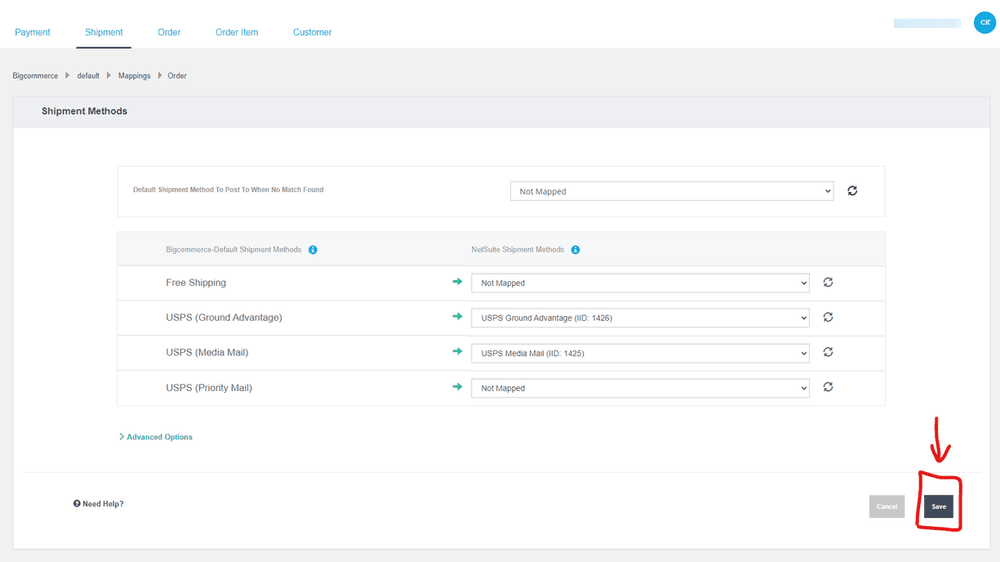
When initially setting up the NetSuite Connector for BigCommerce, follow these steps to avoid Order Sync errors related to Payment Methods and Shipping Methods.